Loading masterpieces...
Back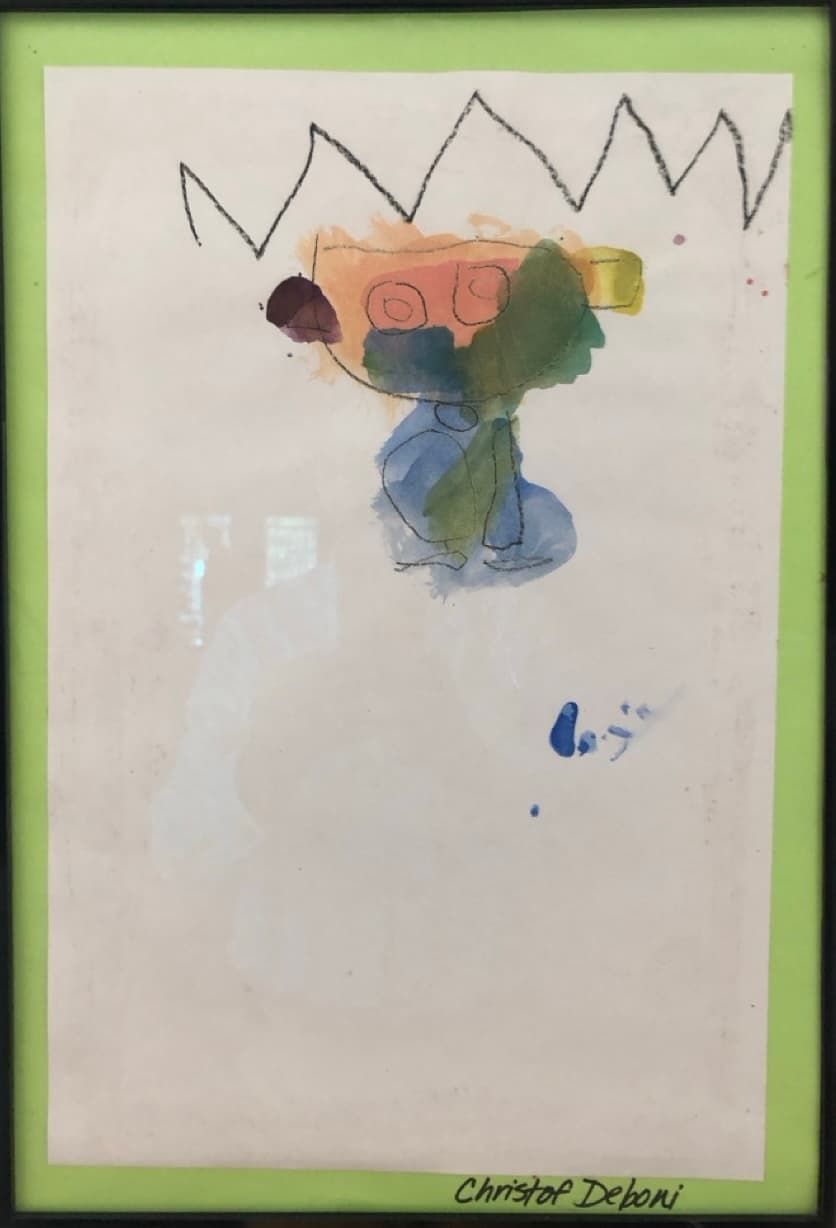
The Green Bowtie
Christof D.
Expressionism
Critic's Review
Christof D.'s work often focuses on the themes of transition, rebellion and the conflict between mind and body using both pop cultural and historical references. In 'The Green Bowtie', these themes come together and challenge the viewer to understand their intersections. Where do they add power to each other, and where do they negate? The viewer is initially drawn to the irregular jagged line at the top of the piece, signifying its importance to the theme. The bold black line alludes to Charlie Brown's famed shirt and Bart Simpson's spiky hair. The first reference recalls the turbulent and revolutionary 60s, when Peanuts achieved the height of its fame; the second evokes Bart's rebellious and mischievous nature. There should be yellow surrounding the line to make both references complete but Christof denies us the mellowing influence of the colour, leaving us to confront the stark meaning of the line's meaning. Below the line, the components of a boy can be discerned, who is clearly Christof himself. Note the cool colours below the neck and the hotter tones above it. These highlight the inability of the artist's limbs to fully capture the fevered conceptions of beauty dancing in the mind. When viewed with Bart's hairline, Christof admits his nonconformity, while the Charlie Brown stripe reflects young children dealing with adult and societal issues. Christof identifies with that portrayal, reminding us that we're still children in adult bodies, universally unequipped to handle these complex dilemmas. The green bowtie, normally a decorative adornment, is charged with holding the disparate body parts together. It's a hopeless mission. The outsized tie is deformed by the strain and appears ready to fly off the neck in a fit of despair. Note also the eyes peering above the tie. Christof is curious about the viewer's reaction, seemingly hopeful to witness the viewer's discomfort. Below the neck, more abstractions and allusions. The torso is reduced to a mere pebble, incapable of carrying the weight of Christof's ambition, yet the head remains balanced. The feet, irregular and unjointed, emphasize the artist's clumsy and uneven journey to arrive at his unpleasant truths. Here Christof is clearly alluding to the simplicity and abstraction of Picasso's Woman Throwing a Stone as well as to the subconscious rebellion of Dali's Soft Construction with Boiled Beans (Premonition of Civil War). Where are hands? They seem to be missing but Christof has located them beneath his feet (really, beneath nearly everything). There they lie — abstracted and unrecognisable. We are invited to join Christof in his despair at these incompetent tools. But there's another message. It's the artist's statement to his critics yearning for realism and concreteness. Christof will not acquiesce to these simple demands because his hands don't acquiesce. They can't. Nature doesn't allow them. And art must be honest to nature.
0